I Got My First Subscriber. Here's What Happened After I Built My MVP.
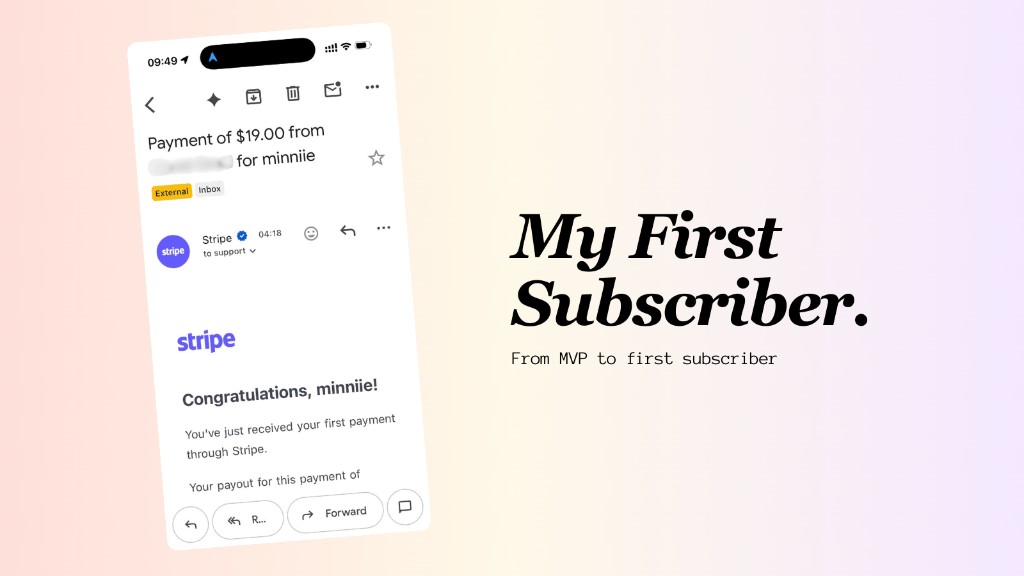
A few weeks ago, while I was on holiday in Copenhagen, I woke up and checked my phone.
There it was.
A new Stripe notification.
Someone had subscribed to minniie.
It was only one subscriber.
But I smiled.
Not because of the number.
Because someone I had never met found the product, understood what it does, and decided it was worth paying for.
Moments like this remind me why I love building digital products.
Once you've built the foundation, your product keeps working even when you're away. Whether you're sleeping, travelling, or having breakfast in another country, someone can discover what you've built and decide it's exactly what they were looking for.
That feeling is hard to describe.
But what surprised me even more was this:
Building the MVP turned out to be the easy part.
The real work only started afterwards.
I built the MVP with Lovable, and once the core functionality was there, I slowly started replacing the generated interface with my own React, Tailwind and TypeScript UI kit. At that point I could have kept adding features. There was still a long wishlist.
But another feature wasn't going to bring the first customer.
People first needed to find the product.
So I switched from building software to building a marketing system.
My First Goal Wasn't Social Media
I think most founders immediately jump into Instagram, TikTok or paid ads.
I didn't.
Instead, I spent days making sure Google, and increasingly AI, actually understood what minniie is.
I lived inside Google Search Console, submitting pages, requesting indexing, checking which pages Google had already discovered and figuring out why others weren't indexed yet.
At the same time I started running AI audits on the site. Not just quick SEO checks, but structured reviews where I asked AI to look at minniie the way a small pro team would.
A developer. A UX designer. A growth person.
Each with a different lens.
"What would a developer flag here?"
"What feels unclear from a UX perspective?"
"What would a growth team improve first?"
I still do this. It's not a one-time thing. It's an ongoing process, and I'm still working through the findings.
One thing that kept coming back, again and again: LinkedIn.
Surprisingly, it showed up in almost every audit as a major driver of SEO and visibility for the site. Not just as a social channel, but as something actively pushing minniie forward in search and discovery.
Not only from an SEO perspective. But from an LLM visibility perspective too.
"What pages are missing?"
"What would make AI understand my product better?"
"What questions would users search for?"
Almost every conversation ended with another improvement.
Another landing page.
Another clearer headline.
Another feature description rewritten.
Little by little, the product became easier to understand. Not only for people, but also for AI.
One Question I Keep Asking Google
There's one question I ask surprisingly often.
"What is minniie.com?"
It's such a simple prompt. But it tells me almost everything.
If Google's answer doesn't sound like the product I have in my head, I know my messaging still isn't good enough.
So I go back.
Rewrite a headline.
Adjust a landing page.
Improve the documentation.
Sometimes I ask ChatGPT. Sometimes Gemini. Sometimes Perplexity.
I don't really care which AI gives the answer.
I'm simply trying to make sure that every one of them understands minniie in roughly the same way.
I think this has become one of my favorite ways of testing messaging.
Building Pages Before Building Followers
Instead of trying to create viral posts, I started creating pages around things people were already searching for.
Digital wardrobe.
Color analysis.
Capsule wardrobe.
AI wardrobe app.
Outfit planner.
Packing lists.
Closet organization.
Every page answered a real question.
I also spent a lot of time simply Googling.
Whenever I found a page ranking well, I didn't copy it. I tried to understand why it ranked.
What questions did it answer?
How was it structured?
What made it genuinely useful?
Then I built my own version around minniie.
One example is the article about the best wardrobe apps in 2026.
Exactly the type of search where I hope people discover minniie one day.
Documentation Quietly Became Marketing
Another thing I didn't expect was how useful documentation would become.
I built a dedicated docs page where I documented every feature inside minniie.
Originally, it was just for users. But then I realized something.
Those pages also explain the product to Google. And to AI.
Instead of features being hidden behind a login, they're now described in a structured way that's easy to index and understand.
I think documentation is becoming much more than customer support.
It's slowly becoming part of marketing.
Context Matters More Than Links
One thing I've noticed while learning more about LLM visibility is that I think we're slowly moving away from obsessing over backlinks.
Don't get me wrong. Links still matter.
But AI doesn't only follow links.
It reads. It understands context.
So I started mentioning minniie naturally across my other projects whenever it genuinely fits.
Writing about it.
Linking to it.
Explaining why I built it.
Not because I wanted another backlink.
But because I wanted the internet to actually understand what minniie is.
AI Slowly Became My Marketing Team
AI has probably become my biggest productivity boost during this phase.
I use Comet almost like a research assistant.
I'll ask it to find websites accepting guest posts, collect contact details, open Gmail, and prepare outreach emails.
By the time I sit down, most of the repetitive work is already done. I just review, personalize and send.
For browser-based work, Comet currently feels incredibly fast.
But something interesting happened.
The more I used it, the more I realized that many of these weren't one-off tasks anymore.
They became repeated workflows.
That's when I started moving more and more of them into Claude Cowork.
Today I'm building reusable systems for things like:
- Instagram outreach
- guest article outreach
- Reddit research
- recurring marketing tasks
- scheduled research
- weekly reports
Instead of asking AI to repeat the same task every day, I'm trying to teach it how I work.
That feels like a much more interesting direction.
I wrote more about which tool takes which role in how I use AI across my workflow.
Social Media Can Wait
Of course I also created minniie's social channels.
Instagram. LinkedIn. Pinterest. TikTok.
But honestly... they're still tiny.
And I'm completely okay with that.
Right now I'd rather build a strong foundation than chase followers.
One thing I'm currently building is an AI-supported social media workflow.
Not because I want AI to replace creativity. Quite the opposite.
I want AI to take care of the repetitive work so I can spend more time writing, sharing ideas and collaborating with people.
I Even Built My Own Content Tool
One feature I recently added inside minniie is an AI-powered visual creator.
Originally, I built it for myself.
I wanted a quicker way to create visuals that actually looked and felt like minniie.
It's already helped me create my first posts, graphics and even short videos.
Will AI build an authentic brand?
No.
Brands are built by stories. People. Opinions. Creators. Conversations.
But AI can remove a lot of the friction between having an idea and publishing it.
And that's exactly how I want to use it.
Then Something Unexpected Happened
After all of that...
My first subscriber didn't come from Google. Or Reddit. Or Pinterest.
It came from LinkedIn.
I honestly didn't expect that, even though my audits had been flagging it for weeks.
LinkedIn turned out to be surprisingly good for SEO and visibility. Every time I ran an audit, the feedback came back the same way: LinkedIn was giving minniie a real push. In search, in discovery, in how the product showed up online.
So when the first subscriber arrived from there, it wasn't random. It was the signal catching up with what the audits had already been telling me.
But it reminded me that people rarely discover a product through a single touchpoint.
Maybe someone reads a blog article.
Then sees a LinkedIn post.
Later Googles the product.
Eventually asks ChatGPT about it.
Then signs up.
Marketing isn't one moment.
It's dozens of tiny moments that slowly build trust.
Final Thoughts
Getting my first subscriber made me incredibly happy.
Not because it suddenly changed the business.
It didn't.
But it was proof that the foundation was starting to work.
The product had become discoverable.
Someone found it.
Someone understood it.
Someone trusted it enough to pay.
And that happened while I was walking around Copenhagen.
I think that's one of the most beautiful things about building digital products.
Once you've put in the work, your product has the opportunity to keep working for you.
Now I'm simply trying to make that happen a little more often.
One landing page.
One article.
One experiment.
One improvement at a time.
Keep reading
More from the magazine
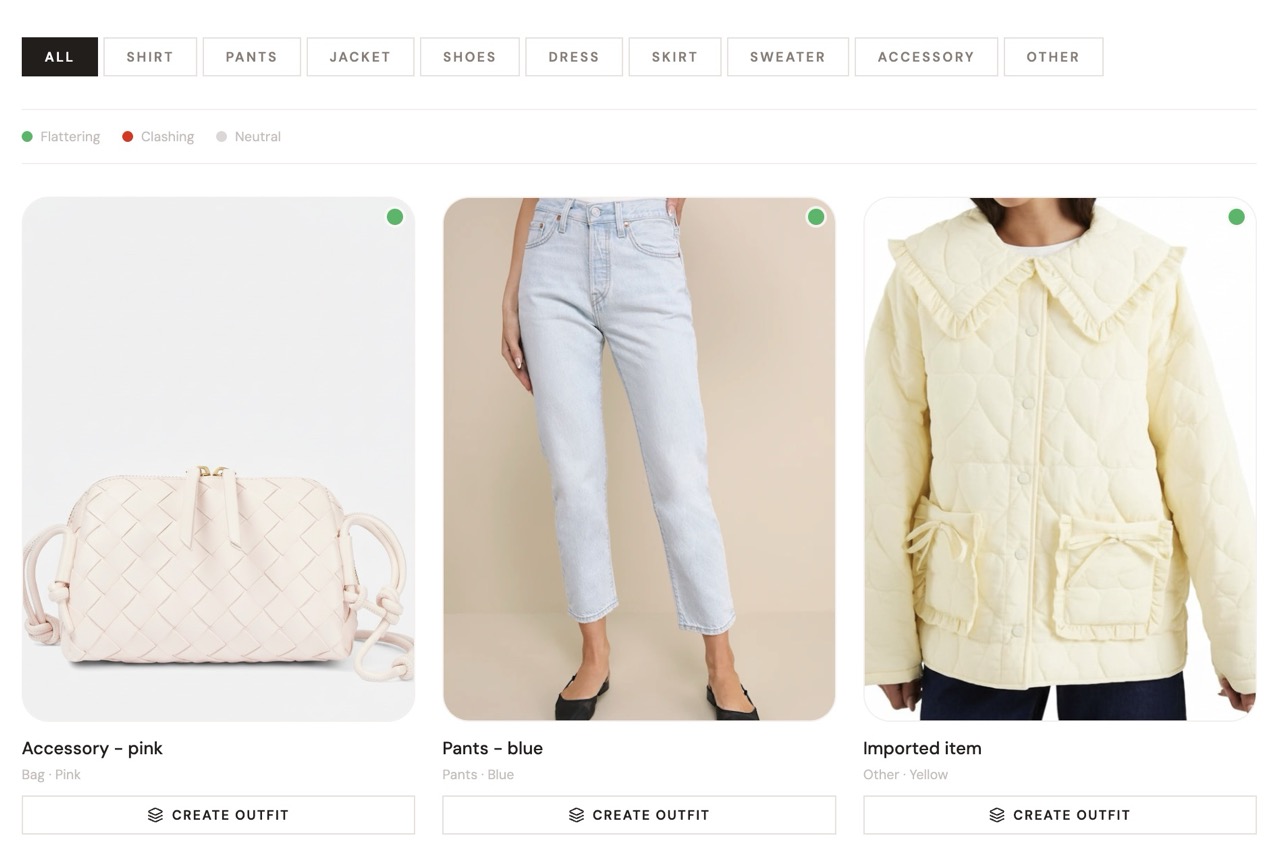
How I Built a Product in One Day With Lovable — and Turned It Into a Real Product With My UI Kit
I built a working AI product in one day using Lovable — then transformed it from a prototype into a polished product by adding my own UI kit on top.
How I Use AI Across My Workflow (and What Each Tool Is Actually Good For) — As of April 2026
AI works best when you treat it as a system, not a single tool. Here's how I use Claude Cowork, ChatGPT, Perplexity, Comet, Gemini, Cursor, and more — and what each one is actually good for.
These UI decisions doubled revenue in a real SaaS product. Now you can preview, buy and use them too.