I Built UI Kits From Real SaaS Work — You Can Drop Them In for a Polished UI
AI can now generate entire apps.
You describe the idea, and suddenly you have authentication, a dashboard, database tables, and several pages already running. Tools like Lovable, along with other AI builders, have dramatically lowered the barrier to building software.
What used to take weeks can now take hours.
But after experimenting with these tools and building several products with them, one thing becomes clear very quickly:
AI can generate software, but it still struggles to generate great product design.
And that's exactly why UI kits are becoming even more important — not less.
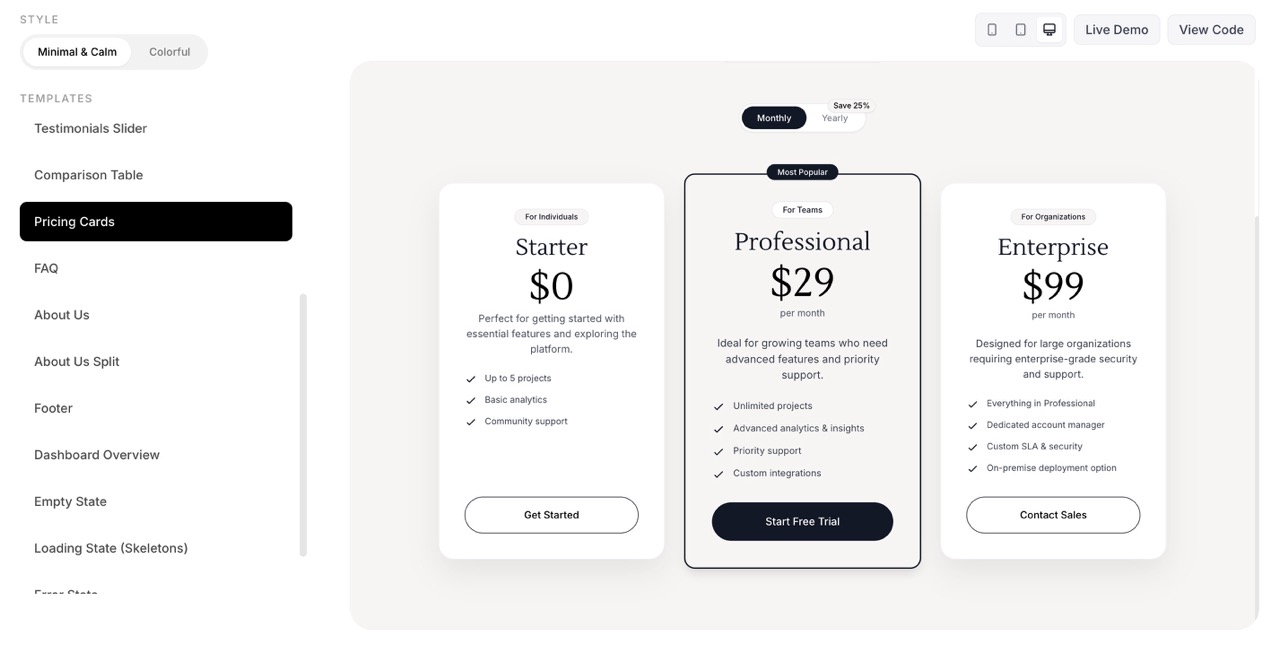
AI Is Great at Structure, Not at Taste
AI builders are extremely good at generating structure:
- forms
- dashboards
- CRUD interfaces
- database logic
- authentication flows
But product design is not just structure.
It's about hierarchy, spacing, rhythm, tone, and visual clarity.
Most AI-generated interfaces tend to look very similar:
- generic layouts
- flat design hierarchy
- missing product storytelling
- weak onboarding experiences
The result often works technically, but doesn't feel like a real product yet.
The Difference Between a Prototype and a Product
Many AI-built apps fall into the same trap.
They are technically functional but visually unfinished.
What's often missing are the elements that make a product feel complete:
- navigation structure
- well-designed content sections
- social proof blocks
- FAQ sections
- conversion-focused layouts
- visual consistency across pages
These elements are rarely generated automatically by AI.
But they are exactly what makes users trust a product.
This is where UI kits come in.
UI Kits Turn AI Projects Into Real Products
A good UI kit acts as a design system and product foundation at the same time.
Instead of starting from empty layouts, builders can immediately work with components that already solve common product design problems.
Typical UI kit components include:
- navigation systems
- product hero sections
- dashboards and card layouts
- social proof modules
- FAQ blocks
- onboarding layouts
- marketing page structures
By using these elements, a generated product can quickly move from "AI prototype" to "real product."
The Rise of "Vibe Coding"
A new wave of builders has appeared with AI development tools.
Many people now build products by describing ideas, guiding the system, and iterating quickly — a process often called "vibe coding."
But vibe coding has a limitation.
While AI can generate functionality, it rarely produces polished interfaces that feel intentional.
Without a strong UI structure, many projects end up looking like:
- developer dashboards
- AI-generated templates
- unfinished prototypes
UI kits provide the missing layer of design quality.
They help builders ship products that look professional even when development is extremely fast.
Speed Changes the Role of Product Builders
One interesting shift that becomes visible when using AI product builders is how the role of building software changes.
The bottleneck is no longer writing code.
The bottleneck is deciding:
- what problem to solve
- how the product should feel
- how the experience should guide the user
Instead of writing everything manually, builders now spend more time:
- structuring the product
- guiding AI systems
- designing the experience
- shaping the interface
UI kits support this shift by removing the need to repeatedly design common product components.
They allow builders to focus on product thinking instead of layout mechanics.
The Future: AI + Design Systems
AI will continue improving.
Interfaces generated by AI will also improve over time.
But even in a future where AI design becomes better, structured design systems will likely remain essential.
Because products are not only about visual style.
They are about consistency, clarity, and product communication.
UI kits help maintain these qualities.
They act as the design backbone that AI-generated applications can build upon.
AI is dramatically accelerating how quickly we can build software.
But building faster does not automatically mean building better.
Great products still require:
- thoughtful design
- clear structure
- intentional user experience
UI kits help bridge the gap between AI-generated functionality and real product design.
And as AI lowers the barrier to building software, that gap may become even more important to fill.
These UI decisions doubled revenue in a real SaaS product. Now you can preview, buy and use them too.